Thanatotheristes
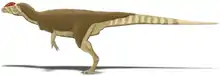
Thanatotheristes (meaning "reaper of death" according to the original authors;[1] literally, "death harvester" in Greek: Θάνατος, romanized: Thánatos, "Death"[3] and θεριστής, romanized: theristḗs, "harvester"[4]) is a genus of tyrannosaurid dinosaur from the Late Cretaceous of Laramidia, approximately 80.1-79.5 Ma. Thanatotheristes contains only one species, T. degrootorum, which may actually be the same animal as Daspletosaurus. Fossils of this taxon are found in the Foremost Formation of Alberta, Canada, coexisting with medium-sized ceratopsids like Xenoceratops foremostensis and small pachycephalosaurids like Colepiocephale lambei.
| Thanatotheristes | |
|---|---|
Scientific classification  | |
| Kingdom: | Animalia |
| Phylum: | Chordata |
| Clade: | Dinosauria |
| Clade: | Saurischia |
| Clade: | Theropoda |
| Family: | †Tyrannosauridae |
| Subfamily: | †Tyrannosaurinae |
| Clade: | †Daspletosaurini |
| Genus: | †Thanatotheristes Voris et al., 2020[1] |
| Type species | |
| †Thanatotheristes degrootorum Voris et al., 2020[1] | |
| Synonyms[2] | |
| |
Discovery and naming
The holotype specimen of Thanatotheristes degrootorum (TMP 2010.5.7) is based on a right maxilla, right jugal, right postorbital, right surangular, right quadrate, right laterosphenoid, left frontal, and both dentaries. The length of the skull has been approximated to be 800 millimetres (31 in). It was smaller than the closely related Daspletosaurus, but the holotype individual was not osteologically mature at the time of death. A referred specimen, TMP 2018.016.0001, is based solely on a partial right maxilla from a subadult individual. It was found at the Twelve Mile Coulee in the upper Herronton Sandstone of the Foremost Formation. The specific name honours John and Sandra De Groot, who discovered the type specimen.[1]
Description
T. degrootorum is characterised by:[1]
- A single row of evenly spaced dorsoventrally oriented ridges on the subcutaneous surface of the maxilla ventral and anteroventral to the antorbital fossa.
- Rounded and inflated orbital margin of the jugal.
- Sagittal crest on the frontal extends anterior to the supratemporal ridge as a broad and rounded ridge.
- Lacrimal contact surface on the frontal extends anteromedially at ~60° relative to interfrontal suture.
- Prefrontal with two posteriorly projecting prongs articulating with the frontal on ventral surface of skull roof (long, medial, primary prong and shorter secondary, lateral prong).
The type specimen of Thanatotheristes has been estimated at about 8 m (26 ft), based on the skull material and comparisons with related genera.[5]
Classification
The formal description of T. degrootorum erected a new tribe within Tyrannosauridae, Daspletosaurini, a sister taxon to Tyrannosaurini. It includes T. degrootorum, Daspletosaurus torosus, D. horneri, and a tyrannosaurid from the Dinosaur Park Formation (FMNH PR308). The existence of Daspletosaurini shows that there is geographic segregation of clades within Tyrannosauridae, with the clade of Bistahieversor and the clade formed by Lythronax and Teratophoneus living in the south of Laramidia, and Albertosaurinae and Daspletosaurini occupying Canada and northern USA.[1]
Daspletosaurini is diagnosed by the following characteristics:[1]
- The presence of an extremely coarse subcutaneous surface of the maxilla anteroventral to the antorbital fossa.
- A constricted jugal ramus of maxilla.
- The anteroventral corner of the maxilla tapers into a shallow angle (<65°) as measured between the alveolar margin of the first two alveoli and the anterior margin of the subcutaneous surface.
- A prefrontal that is broad in dorsal view and strongly dorsomedially arced in anterior view.
- A dentary chin located ventral to either the third alveolus or third interdental plate.
- Possesses no fewer than 14 maxillary teeth.
The cladogram below is the result of the phylogenetic analysis performed by Voris et al. (2020):[1]
| Eutyrannosauria |
| ||||||||||||||||||||||||||||||||||||||||||||||||||||||||||||||||||||||||||||||||||||||||||||||||||||||||||||
An analysis of a subadult Daspletosaurus torosus frontal by Yun, 2020 suggests that features of the bone would effectively demonstrate that autapomorphies of some tyrannosaurid taxa would be inadequate, due to the broad range in morphology of frontals within particular clades. This may suggest that any autapomorphies or synapomorphies pertaining to the frontal of T. degrootorum are inadequate, and may therefore render it a species of Daspletosaurus.[2]
References
- Voris, Jared T.; Therrien, Francois; Zelenitzky, Darla K.; Brown, Caleb M. (2020). "A new tyrannosaurine (Theropoda:Tyrannosauridae) from the Campanian Foremost Formation of Alberta, Canada, provides insight into the evolution and biogeography of tyrannosaurids". Cretaceous Research. 110: 104388. doi:10.1016/j.cretres.2020.104388.
- Chan-gyu Yun (2020). "A Subadult Frontal of Daspletosaurus torosus (Theropoda: Tyrannosauridae) from the Late Cretaceous of Alberta, Canada with Implications for Tyrannosaurid Ontogeny and Taxonomy". PalArch's Journal of Vertebrate Palaeontology. 17: 1–13.
- "Thanatos, n." OED Online. Oxford University Press. September 2014. Retrieved November 18, 2014.
- "harvester - Wiktionary". en.wiktionary.org.
- Black, Riley (February 10, 2020). "Newly Discovered Tyrannosaur Was Key to the Rise of Giant Meat-Eaters". Smithsonian. Retrieved February 11, 2020.
| |||||||||||||||||||||||||||||||||||||||||||||||||||||||||
| |||||||||||||||||||||||||||||||||||||||||||||||||||||||||
| |||||||||||||||||||||||||||||||||||||||||||||||||||||||||
| |||||||||||||||||||||||||||||||||||||||||||||||||||||||||
| |||||||||||||||||||||||||||||||||||||||||||||||||||||||||
| |||||||||||||||||||||||||||||||||||||||||||||||||||||||||
| |||||||||||||||||||||||||||||||||||||||||||||||||||||||||
.jpg.webp)

.jpg.webp)


.png.webp)


.jpg.webp)

