Candes-Saint-Martin
Candes-Saint-Martin (Latin: Candia Sanctus Martinus) is a commune in the Indre-et-Loire department in central France. It overlooks the confluence of the Vienne and Loire rivers from a steep hill on the left bank of the Loire, and marks the boundary between the modern departments of Indre-et-Loire to the east, and Maine-et-Loire to the west.
Candes-Saint-Martin | |
|---|---|
 View over the Loire | |
.svg.png.webp) Coat of arms | |
Location of Candes-Saint-Martin 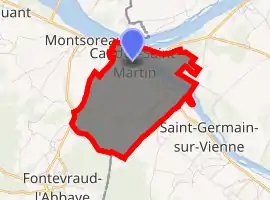
| |
  Candes-Saint-Martin  Candes-Saint-Martin | |
| Coordinates: 47°12′42″N 0°04′27″E | |
| Country | France |
| Region | Centre-Val de Loire |
| Department | Indre-et-Loire |
| Arrondissement | Chinon |
| Canton | Chinon |
| Government | |
| • Mayor (2008–2014) | Lise Couëdy-Gruet |
| Area 1 | 5.77 km2 (2.23 sq mi) |
| Population (2017-01-01)[1] | 199 |
| • Density | 34/km2 (89/sq mi) |
| Time zone | UTC+01:00 (CET) |
| • Summer (DST) | UTC+02:00 (CEST) |
| INSEE/Postal code | 37042 /37500 |
| Elevation | 27–101 m (89–331 ft) |
| 1 French Land Register data, which excludes lakes, ponds, glaciers > 1 km2 (0.386 sq mi or 247 acres) and river estuaries. | |
Name

The name Candes is thought to derive from a Gallic word for confluence, and is found in several other similarly sited towns in the region; the termination Saint-Martin was formally added in 1949, although it had been in common usage for many years. Evidence of Gallo-Roman occupation was found in 19th century excavations, particularly in the grounds of the Bishop's Palace which crowns the hill.
The village takes its name - and its main claim to fame- from the magnificent church which has succeeded the 4th century monastery where St Martin, Bishop of Tours and 'Apostle to the Gauls', died in 397.
Population
| Year | Pop. | ±% |
|---|---|---|
| 1793 | 638 | — |
| 1800 | 525 | −17.7% |
| 1806 | 631 | +20.2% |
| 1821 | 719 | +13.9% |
| 1831 | 748 | +4.0% |
| 1836 | 750 | +0.3% |
| 1841 | 749 | −0.1% |
| 1846 | 721 | −3.7% |
| 1851 | 711 | −1.4% |
| 1856 | 664 | −6.6% |
| 1861 | 630 | −5.1% |
| 1866 | 613 | −2.7% |
| 1872 | 518 | −15.5% |
| 1876 | 482 | −6.9% |
| 1881 | 437 | −9.3% |
| 1886 | 420 | −3.9% |
| 1891 | 412 | −1.9% |
| 1896 | 388 | −5.8% |
| 1901 | 362 | −6.7% |
| 1906 | 320 | −11.6% |
| 1911 | 327 | +2.2% |
| 1921 | 291 | −11.0% |
| 1926 | 238 | −18.2% |
| 1931 | 222 | −6.7% |
| 1936 | 250 | +12.6% |
| 1946 | 252 | +0.8% |
| 1954 | 313 | +24.2% |
| 1962 | 294 | −6.1% |
| 1968 | 264 | −10.2% |
| 1975 | 269 | +1.9% |
| 1982 | 268 | −0.4% |
| 1990 | 244 | −9.0% |
| 1999 | 227 | −7.0% |
| 2006 | 222 | −2.2% |
| 2009 | 222 | +0.0% |
References
- "Populations légales 2017". INSEE. Retrieved 6 January 2020.
 |
Wikimedia Commons has media related to Candes-Saint-Martin. |


Authority control  |
|
|---|